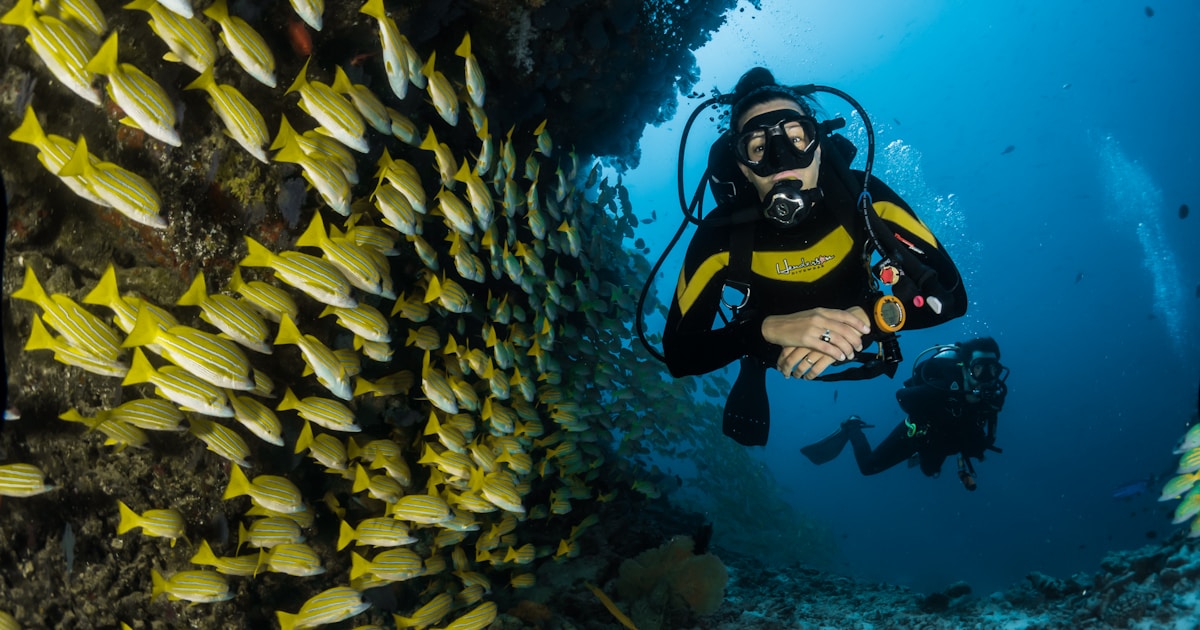
I learned to scuba dive in a swimming pool at Sandos Playacar. Professional instructors walked me through the basics right there in the resort pool — breathing techniques, mask clearing, hand signals, buoyancy control — and then they put me on a boat and dropped me into the ocean on top of the Mesoamerican Reef System, the second-largest barrier reef on the planet.
That trip changed how I think about vacation. I went from someone who had never breathed underwater to someone swimming over coral formations the size of cars, surrounded by parrotfish, sea fans, and nurse sharks — all in the span of a few hours. I documented the entire experience on video: Watch the full dive playlist on YouTube.
You can read more about how that trip turned into this entire business on my About page.
What Is the Mesoamerican Reef?
The Mesoamerican Barrier Reef System is the largest coral reef in the Western Hemisphere and the second-largest on Earth, after Australia’s Great Barrier Reef. It stretches more than 600 miles from the tip of the Yucatan Peninsula south through Belize, Guatemala, and the Bay Islands of Honduras.
The section off Playa del Carmen and Cozumel is some of the most accessible reef diving in the Western Hemisphere. The reef runs parallel to the coastline, often less than a mile offshore. Water temperatures hover between 78°F and 84°F year-round. Visibility on a good day exceeds 100 feet. You do not need to be an experienced diver or travel to a remote island to experience world-class reef diving — it is right there, minutes from your resort.
The reef supports over 500 species of fish and 65 species of hard coral. On a single dive you might see spotted eagle rays, green sea turtles, moray eels, barracuda, lobster, and dozens of species of tropical fish. During certain seasons, whale sharks pass through the waters off Isla Mujeres just north of here — I swam with one on that same trip, and it rewired my brain about what is possible in the ocean.
Diving for Beginners: Discover Scuba and Resort Courses
You do not need a certification to dive the Mesoamerican Reef. The Discover Scuba Diving program (sometimes called a resort course) is designed for people who have never breathed underwater before. Here is how it works:
Classroom session (30-60 minutes). Your instructor covers the basics: how the equipment works, how to equalize ear pressure, hand signals for communication underwater, and what to do if something goes wrong. Nothing complicated — the equipment does most of the work.
Pool practice (1-2 hours). This is where I started at Sandos Playacar. You learn to breathe through the regulator, clear water from your mask, control your buoyancy, and get comfortable being underwater. The pool is shallow and controlled. By the time you are done, breathing underwater feels surprisingly natural.
Open water dive (1 dive, 30-40 minutes). A shallow ocean dive, usually 30-40 feet deep, with your instructor right beside you the entire time. This is where it gets real. You descend onto the reef and suddenly you are surrounded by everything you have seen in nature documentaries. Fish are not afraid of you. Coral is everywhere. The colors are brighter than you expected.
No prior certification is needed. You can go from zero experience to diving the reef in a single day. The program is available through Seek & Go or local dive operators near Sandos Playacar and Sandos Caracol. Check the Seek & Go Riviera Maya page for tour booking details.
What to expect physically: The biggest adjustment is ear pressure. As you descend, you need to equalize by pinching your nose and gently blowing — similar to what you do on an airplane. Some people find this easy; others need a few tries. Your instructor will go slow. The second thing that surprises people is how calm it feels once you relax. Your breathing slows down, you start floating neutrally, and the reef world opens up around you.
Certified Diver Options
If you already have your PADI Open Water or equivalent certification, Playa del Carmen and the surrounding area offer dozens of dive sites within 15 minutes by boat. The variety is exceptional:
Reef dives range from shallow (30-50 feet) to deep (80-100 feet). Shallow reefs are great for relaxed diving with maximum color and light. Deep reefs tend to have bigger marine life and more dramatic coral formations.
Drift dives let the current do the work. You drop in, the current carries you along the reef, and the boat picks you up downstream. Playa del Carmen has consistent currents that make drift diving effortless and fun.
Night dives are a completely different experience. The reef transforms after dark — octopus come out to hunt, bioluminescent plankton glow when you move through the water, and lobsters wander the reef face by the hundreds.
Key Dive Sites Near Sandos Resorts
Barracuda Reef — A shallow reef popular with photographers. Large schools of barracuda circle overhead while reef fish dart through the coral below.
Tortugas Reef — Named for the sea turtles that frequent this site. Shallow, calm, and excellent visibility. A favorite for both beginners and experienced divers.
Jardines Reef — “The Gardens.” Dense coral formations with an incredible diversity of fish species. One of the most colorful dives in the area.
Mama Viña — An artificial reef created from a sunken shrimp boat. The hull is encrusted with coral and sponges, and the interior is home to moray eels, lionfish, and schools of snapper. The wreck sits in about 75 feet of water and is accessible to Open Water certified divers.
Cenote Diving
Cenote diving is a completely different experience from ocean diving, and it is unique to the Yucatan Peninsula. Cenotes are natural sinkholes formed when limestone bedrock collapses, exposing the underground river system that runs beneath the entire peninsula.
The water is crystal-clear freshwater — visibility can exceed 200 feet. The caverns are cathedral-sized, with stalactites and stalagmites formed over millions of years. Light filters down from openings above, creating beams that cut through the darkness like spotlights. It is otherworldly.
One of the most fascinating phenomena is the halocline — the layer where fresh water meets salt water deep underground. When you swim through it, your vision distorts like looking through wavy glass. It is a surreal visual effect that photographs and video cannot fully capture.
Popular Cenotes for Diving
Cenote Dos Ojos — “Two Eyes.” One of the most popular dive cenotes, with two connected caverns. The Bat Cave passage is famous for a moment where your guide turns off all the lights and you float in absolute darkness before the cavern opens up again. Accessible to Open Water certified divers with a cavern guide.
Cenote Pit — A deep cenote (120 feet) with a hydrogen sulfide cloud at around 100 feet that looks like an underwater fog bank. Light beams from the surface penetrate deep into the water. Advanced Open Water certification recommended.
Cenote Angelita — Home to an underwater “river” — a dense layer of hydrogen sulfide at about 90 feet that looks exactly like a flowing river sitting on the cavern floor, complete with fallen trees and branches. One of the most surreal dive sites on the planet. Advanced Open Water required.
Important: Some cenotes are accessible to Discover Scuba participants or Open Water divers with a guide. Others — particularly deep caverns and those with overhead environments — require Advanced Open Water or Cavern/Cave certification. Always dive with a certified cenote guide. This is non-negotiable.
For more on cenotes, read our complete guide: Best Cenotes Near Sandos Resorts.
Bull Shark Diving (November–March)
Playa del Carmen is one of the only places in the world where you can reliably dive with bull sharks in their natural environment. Every winter, female bull sharks migrate to the warm, shallow waters off the coast — and local dive operators know exactly where they gather.
Here is what the dive looks like: you descend to about 75 feet and kneel on the sandy bottom in a line with other divers. The dive master positions the group. Then the sharks come. Bull sharks — 8 to 10 feet long, stocky, powerful — cruise past at arm’s length. There is no cage. No bait in the water during the dive. Just you, the sand, and apex predators doing their thing.
Requirements: Certified divers only. Advanced Open Water is strongly recommended due to depth (75 feet) and the need for excellent buoyancy control. You do not want to be flailing around near bull sharks. This dive requires calm, controlled movement.
Season: November through March. Peak months are January and February.
Is it safe? The operators who run these dives have been doing it for years with an excellent safety record. Bull sharks in this area are not aggressive toward divers — they are accustomed to human presence. That said, these are wild animals and you need to respect the dive master’s instructions completely.
Cozumel — World-Class Drift Diving
Cozumel is a 45-minute ferry ride from Playa del Carmen and is consistently ranked among the top 10 dive destinations on Earth. Jacques Cousteau put Cozumel on the diving map in the 1960s, and it has only gotten better since marine park protections were established.
What makes Cozumel special is the drift diving. The island sits in a consistent south-to-north current. You drop into the water, the current carries you along the reef wall, and you simply fly. No kicking, no fighting the current — just floating along a wall of coral that drops away into deep blue below you.
Signature Cozumel Dive Sites
Palancar Reef — A massive reef system with towering coral pinnacles, swim-throughs, and tunnels. The reef has multiple sections (Palancar Gardens, Palancar Caves, Palancar Horseshoe) that offer different experiences at different depths.
Colombia Reef — Deep (80-100 feet) with massive coral formations the size of buildings. Big marine life — large grouper, turtles, spotted eagle rays. One of the most dramatic reef structures in the Caribbean.
Santa Rosa Wall — A sheer wall dive. You drift along a vertical coral cliff that drops hundreds of feet into darkness below. Overhangs, tunnels, sponges the size of bathtubs. A bucket-list dive for any certified diver.
Visibility regularly exceeds 100 feet, sometimes approaching 200. Water temperature stays between 78°F and 82°F year-round.
Cozumel is an easy day trip from any of the Playa del Carmen Sandos resorts. Take the ferry from the Playa del Carmen pier (10 minutes from Sandos Playacar), dive all morning, have lunch on the island, and ferry back in the afternoon.
Snorkeling Alternative
Not ready for scuba? The Mesoamerican Reef is shallow enough in many areas for excellent snorkeling right from the surface. You will see many of the same fish, coral, and marine life without the equipment or training.
Akumal Bay — Famous for sea turtles. The turtles graze on seagrass in the shallow bay and are so accustomed to snorkelers that they barely react to your presence. A guided snorkel tour is required (to protect the turtles from being touched or harassed).
Xel-Há — A natural inlet where fresh and salt water mix. The park operates as an all-inclusive snorkeling destination with equipment, food, drinks, and lockers included. Great for families and first-time snorkelers.
Puerto Morelos Reef — A national marine park with a reef just 500 meters offshore. Less crowded than the more famous spots. Excellent coral health due to strict protections.
Cozumel nearshore reefs — Several reefs along Cozumel’s west coast are shallow enough for snorkeling from the beach or a short boat ride.
Check the Seek & Go Riviera Maya page for snorkeling tour options.
What About Cabo?
The diving at Sandos Finisterra in Cabo San Lucas is a completely different experience. The Sea of Cortez — which Jacques Cousteau called “the aquarium of the world” — is not a coral reef environment. It is a deep, nutrient-rich body of water between the Baja Peninsula and mainland Mexico.
What you get instead:
Sand falls — Underwater cascades of sand that pour over the edge of submarine canyons. It looks like an underwater waterfall. Unique to Cabo.
Sea lion colonies — Los Islotes, near La Paz, is home to a colony of playful California sea lions. They approach divers, blow bubbles in your face, and spin around you. One of the most joyful dive experiences in Mexico.
Hammerhead sharks — Schooling hammerheads are spotted at seamounts in the Sea of Cortez, particularly around Cabo Pulmo and Gordo Banks. Seasonal and dependent on conditions, but when they show up, the schools can number in the hundreds.
Cabo Pulmo National Marine Park — A no-take marine reserve that has seen one of the most successful ocean recoveries in the world. Fish biomass has increased by over 400% since protections were put in place. Schools of jacks, grouper, and snapper are so dense they block out the light.
Not reef diving, but equally extraordinary. For tour options, see Seek & Go Los Cabos. For things to do above water, check out Things to Do in Cabo San Lucas.
Practical Information
Getting certified. If you want to get certified before your trip, PADI Open Water takes 3-4 days and is available worldwide. You can also do the classroom and pool portions at home (PADI eLearning) and complete your open water dives in Mexico. Advanced Open Water adds two more days and opens up deeper dives, night dives, and navigation.
Dive shop logistics near Playa del Carmen. Dozens of reputable dive shops operate in Playa del Carmen and along the Riviera Maya. Most offer hotel pickup, equipment rental, and multi-dive packages. Your resort concierge can recommend operators, or book through Seek & Go Riviera Maya.
Equipment rental vs. bringing your own. Unless you dive frequently, rent. Dive shops provide everything — BCD, regulator, wetsuit, mask, fins, tank, weights. If you have your own mask and fins that fit perfectly, bring those. Everything else, rent.
Water temperature by season. Summer (June–September): 82–84°F — a rash guard or thin 3mm wetsuit is plenty. Winter (December–March): 78–80°F — a 3mm wetsuit is recommended, 5mm if you get cold easily. Spring and fall are in between.
Best months for visibility. March through June typically offers the clearest water. Hurricane season (August–October) can reduce visibility after storms, but conditions recover quickly.
Flying after diving. This is critical. After any scuba dive, you must wait at least 18-24 hours before flying. This is not a suggestion — it is a safety requirement to prevent decompression sickness. Plan your last dive day accordingly. If you are diving on your second-to-last day, you are fine. If you want to dive on your last full day, make sure your flight is not until the following evening at the earliest.
Cost. A single-tank reef dive in Playa del Carmen typically runs $50-80 USD. Two-tank dives are $80-120. Cenote dives are $100-180 depending on the cenote and whether it includes transport. Bull shark dives are $150-200. Cozumel day trips with two dives plus ferry are $150-200.
Ready to Dive?
Whether you have never breathed underwater or you are chasing bull sharks and cenote caverns, the Riviera Maya delivers. The Mesoamerican Reef is right there — accessible, warm, and teeming with life.
Promotional packages at Sandos Playacar — where I learned to dive — start at $435 for 3 nights all-inclusive. That gets you the resort, the beach, the food, the drinks, and puts you minutes from some of the best diving on the planet.
Explore Sandos Resorts
- Sandos Playacar — Where I learned to dive, steps from the reef
- Sandos Caracol — Eco-resort in Playa del Carmen, nature-focused
- Sandos Finisterra — Sea of Cortez diving in Cabo San Lucas
- Sandos Cancún — Adults-only, Cancún Hotel Zone
Related Articles
- Best Cenotes Near Sandos Resorts
- Things to Do in Riviera Maya
- Things to Do in Cabo San Lucas
- Is Mexico Safe for Tourists?
- Whale Watching in Los Cabos
- How to Choose Your Sandos Resort
Have questions about diving during your stay? Contact us at contact@sandospromo.com or call 855-804-8381.
Interested in These Resorts?
Tell us your travel dates and we'll find the right fit — no pressure, just information
There's More to Sandos
Discover Everything Sandos Resorts Offer
The promotional stay is just the beginning. Here's what makes Sandos one of Mexico's most complete resort experiences.
Seek & Go Excursions
100+ curated tours — cenotes, ruins, whale watching, catamaran cruises — with resort pickup included.
Browse Tours →Royal Elite Vacation Club
Points-based membership with access to all 4 Sandos resorts plus 6,000+ properties worldwide via RCI exchange.
Learn About Membership →Destination Weddings
Beach, cenote, and rooftop venues. Three all-inclusive packages from $4,200 for 30 guests across Sandos properties in Mexico.
Plan Your Wedding →Wildlife & Nature
Cenotes, sea turtles, whale sharks, and birdwatching. Sandos Caracol is built inside an eco-reserve — wildlife is everywhere.
Explore Nature →Dining & Restaurants
Multiple restaurants per resort — Italian, Mexican, Japanese, international buffet — all included. No extra charges, no reservations needed for most.
See the Restaurant Guide →The Promotional Stay
Stay 4–7 nights at up to 70% off in exchange for a 90-minute vacation club presentation. Full resort access, same amenities, no compromise.
How It Works →